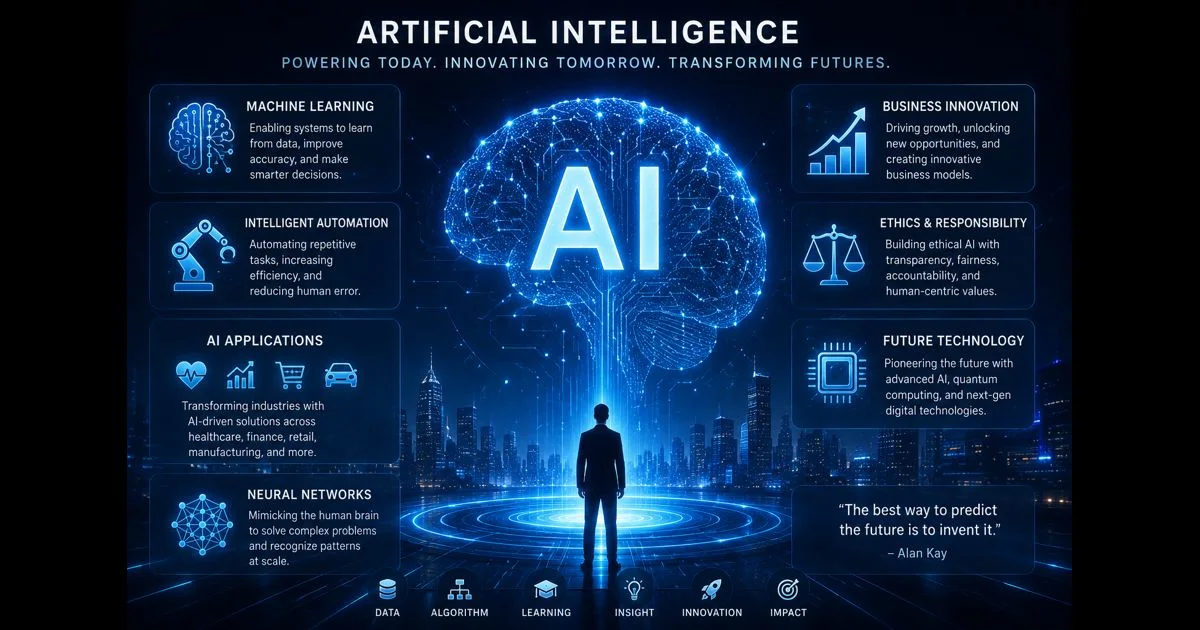
Artificial intelligence is a broad field of computer systems that can recognize patterns, interpret information, generate content, make predictions, or support decisions. Its practical value depends on the task, data, testing, and human oversight surrounding it. AI can improve many workflows, but its outputs are not automatically accurate, fair, secure, or appropriate.
AI is already used in software development, scientific research, manufacturing, finance, healthcare, education, cybersecurity, logistics, and everyday digital services. These applications do not all rely on the same technology or operate with the same level of independence.
A recommendation model, medical imaging system, customer-service assistant, fraud-detection tool, and industrial monitoring platform may all use artificial intelligence. Each system addresses a different problem, works within different limits, and requires controls suited to the consequences of an error.
Understanding AI therefore involves more than knowing what the technology can produce. Organizations also need to understand how models are trained, how their performance is evaluated, where human judgment remains necessary, and who is accountable for the results.
What Is Artificial Intelligence?
Artificial intelligence refers to computer-based systems designed to perform tasks commonly associated with perception, reasoning, learning, language, prediction, or decision support.
Traditional software generally follows rules written directly by developers. For example, a billing system may send an invoice when an order reaches a specified status. Many AI systems work differently: they identify statistical relationships in data and apply those relationships to new inputs.
This allows AI to handle information that may be difficult to process through fixed rules alone, including natural language, images, audio, complex behavioral patterns, and uncertain forecasts.
An AI model’s ability to produce a fluent answer or accurate prediction in one context does not mean it possesses general human understanding. Its behavior remains influenced by its architecture, training data, instructions, connected tools, and operating environment.
Most practical AI systems are built for defined tasks or groups of related tasks. They may perform those tasks effectively while remaining unsuitable for situations that differ from their training or intended use.
AI, Machine Learning, Deep Learning and Automation
Artificial intelligence, machine learning, deep learning, generative AI, and automation describe related but different concepts.
| Technology | What it does | Typical example | Important limitation |
| Artificial intelligence | Performs tasks involving prediction, interpretation, generation, or decision support | Fraud detection or document classification | The term covers many different systems |
| Machine learning | Learns statistical patterns from data | Demand forecasting | Performance depends heavily on relevant data |
| Deep learning | Uses multilayer neural networks to process complex patterns | Image or speech recognition | May require substantial data and computing resources |
| Generative AI | Produces new text, images, audio, video, code, or structured content | Drafting a report | Can create inaccurate or unsupported output |
| Automation | Executes predefined steps with reduced manual effort | Sending an invoice after an order | May not involve AI at all |
| AI agent | Uses models and approved tools to complete a sequence of actions | Reviewing a request and updating a workflow | Greater autonomy creates greater operational risk |
A business should not assume that AI is required for every process. Stable, predictable work can often be handled more reliably through conventional automation. AI becomes more relevant when the task requires classification, prediction, language interpretation, visual analysis, or handling variable information.
The simplest effective approach is often easier to test, explain, secure, and maintain.
How Machine Learning Works
Machine learning uses examples to identify relationships that can be applied to new information. The exact process depends on the model and task, but it generally includes collecting data, preparing it, training a model, evaluating performance, and monitoring results after deployment.
Supervised Learning
Supervised learning uses examples paired with known outcomes. A model may learn from transactions previously categorized as legitimate or suspicious and then estimate the category of a new transaction.
Its reliability depends on the relevance and accuracy of the labels. If historical decisions contain errors or unfair patterns, the model may learn from those weaknesses.
Unsupervised Learning
Unsupervised learning examines data without predefined outcome labels. It can identify clusters, relationships, or unusual observations.
Organizations may use it to explore customer groups, recognize unfamiliar behavior, or identify records that deserve investigation. The detected pattern still requires interpretation; statistical difference does not automatically indicate fraud, risk, or wrongdoing.
Reinforcement Learning
Reinforcement learning improves behavior through feedback received after actions within an environment. It can be useful where a system must select among repeated actions and evaluate their outcomes.
The quality of the result depends on how the objective and feedback are defined. A poorly designed reward can encourage behavior that technically satisfies the metric without achieving the intended purpose.
Deep Learning
Deep learning is a form of machine learning based on neural networks with multiple processing layers. It has supported advances in image analysis, speech recognition, natural language processing, and generative models.
Deep learning systems can model complex relationships, but their internal calculations may be difficult to interpret. They also require testing that reflects the conditions in which they will actually operate.
Core AI Technologies
Different AI technologies address different kinds of information and tasks.
Natural Language Processing
Natural language processing enables systems to analyze or generate human language. It is used in search, translation, transcription, document classification, summarization, and conversational tools.
Language depends on context, tone, culture, and implied meaning. An AI system may therefore misunderstand an ambiguous request or generate an answer that appears convincing without being adequately supported.
Language-based systems used for important work should be connected to reliable information and subject to proportionate review.
Computer Vision
Computer vision analyzes images, video, scanned documents, and other visual data. Applications include product inspection, document processing, medical imaging, agricultural monitoring, and traffic analysis.
Performance may change with lighting, camera position, image quality, equipment, or conditions that differ from the training data. Evaluation should use realistic examples from the intended environment.
Speech and Audio Processing
AI can transcribe speech, identify sound patterns, support voice interfaces, and assist with audio classification.
Results may vary because of background noise, microphone quality, speaking style, language, or accent. These differences are important when an output affects access, assessment, or another consequential decision.
Generative AI
Generative AI produces new material based on patterns learned from training data. Depending on the system, it may generate text, software code, images, audio, video, or structured documents.
Useful applications include:
- Producing an initial draft
- Summarizing supplied information
- Generating software tests
- Organizing documents
- Exploring design alternatives
- Reformatting structured content
- Supporting internal knowledge search
Generated output should not be treated as verified information merely because it is fluent or detailed. A model may produce factual errors, invented references, insecure code, or content that does not match the user’s real requirements.
The NIST Generative AI Profile addresses risks specific to generative systems and provides actions organizations can consider as part of broader AI risk management.
Retrieval-Augmented Generation
Retrieval-augmented generation connects a generative model to selected external information, such as internal policies, approved documents, or a controlled knowledge base.
This approach can make answers more relevant and easier to trace to source material. It does not guarantee accuracy. The retrieved information may be outdated, incomplete, incorrectly ranked, or misunderstood by the model.
Organizations should evaluate both retrieval quality and final-answer quality.
AI Agents
AI agents can pursue an objective through a sequence of actions. An agent may retrieve information, compare records, use approved tools, update a system, or request authorization before continuing.
The main risk is not only an incorrect answer. An agent connected to email, databases, purchasing tools, or production systems can take actions with operational consequences.
Permissions should therefore be limited according to the task. Activity should be logged, sensitive actions should require approval, and the organization should be able to stop or reverse a process when appropriate.
The Role of Data in AI
Data strongly influences how an AI system behaves. A technically advanced model cannot reliably compensate for data that is inaccurate, incomplete, poorly labelled, outdated, or unrelated to its intended environment.
A useful data assessment considers:
- Where the information came from
- Whether it may be used for the intended purpose
- How accurately it was recorded
- Whether important situations are represented
- Whether sensitive information is included
- How the data may change after deployment
- Which information will be reserved for independent testing
More data is not automatically better data. A smaller, relevant, well-documented dataset may be more useful than a large collection assembled without clear quality controls.
Training, Validation and Test Data
Training data is used to fit the model. Validation data supports model selection and adjustment. Test data is kept separate so that performance can be evaluated on examples the model did not use during training.
If test information influences model development too early, reported performance may appear stronger than the system’s ability to handle genuinely new inputs.
Data Drift
Data drift occurs when operational information changes over time. Customer behavior, language, equipment, market conditions, fraud patterns, or business processes may no longer resemble the data used during training.
Monitoring should therefore continue after deployment. Past performance does not guarantee that a model will remain suitable under different conditions.
Data Rights and Privacy
Organizations should confirm that data is collected and used under appropriate permissions, policies, and legal requirements. Personal or confidential information should not be included simply because it is available.
Data minimization can reduce exposure by limiting collection and processing to information genuinely required for the task.
Practical Applications of Artificial Intelligence
AI applications are most useful when they address a defined problem and their performance can be evaluated meaningfully.
| Field | Possible AI application | Human responsibility | Main control |
| Healthcare | Image analysis or clinical information support | Qualified professionals interpret results in context | Clinical validation and oversight |
| Finance | Fraud detection or document review | Staff investigate alerts and exceptions | Fairness testing and escalation |
| Manufacturing | Visual inspection or predictive maintenance | Engineers evaluate findings and safety implications | Real-world performance monitoring |
| Retail | Forecasting or product recommendations | Teams manage data use and customer experience | Privacy and relevance controls |
| Education | Accessibility or learning support | Educators assess student needs | Bias testing and teacher review |
| Logistics | Route or demand planning | Operators handle changing conditions | Reliable operational data |
| Cybersecurity | Alert prioritization or anomaly detection | Analysts investigate and respond | Secure integration and audit logs |
| Software development | Code suggestions or test generation | Developers review correctness and security | Code review and testing |
| Customer service | Request classification or draft responses | Staff manage sensitive and unusual cases | Escalation and quality review |
These are possible applications, not promises of improved performance. Results depend on the data, implementation, workflow, users, and conditions in which each system operates.
Documented Examples of AI in Practice
Real examples help distinguish operational AI from speculative claims. They should still be interpreted within their stated purpose and limitations.
AI-Enabled Medical Devices
The U.S. Food and Drug Administration maintains a public list of AI-enabled medical devices authorized for marketing in the United States. The list includes devices across medical fields, with many entries related to radiology.
The FDA explains that the resource is intended to improve transparency and is not necessarily a complete list of every AI-enabled medical device. Inclusion also does not mean that a device is appropriate for every patient or clinical situation. Each device must be used according to its authorized purpose and relevant professional guidance.
This example shows why healthcare AI must be discussed precisely. AI may assist with a defined medical-device function, but that is different from claiming that a general AI system can independently diagnose or treat patients.
Protein Structure Predictions
The AlphaFold Protein Structure Database provides access to predicted protein structures for scientific research.
These predictions can help researchers explore possible protein shapes and formulate new questions. They do not make experimental research unnecessary. Prediction quality and suitability must still be considered for the particular protein and research purpose.
This example illustrates a productive role for AI: expanding access to useful predictions while preserving the need for scientific interpretation and validation.
AI in Business Operations
Organizations use AI to support document processing, forecasting, customer service, risk analysis, internal search, software development, and operational monitoring.
The value usually comes from improving a complete workflow rather than adding a model in isolation.
For example, an AI-assisted document process may:
- Receive a document through an approved channel.
- Identify the document type.
- extract relevant fields.
- Check whether required information is present.
- Route routine cases to the correct workflow.
- Send uncertain or sensitive cases to an employee.
- Record the result for later review.
The system does not need unrestricted control over the entire process. Its permissions can be limited to classification and routing, while consequential decisions remain with authorized employees.
This type of design supports broader digital transformation without assuming that every step should become autonomous.
When AI Is Appropriate—and When It Is Not
AI is more likely to be useful when:
- The problem is clearly defined.
- Relevant data is available.
- Performance can be measured.
- Errors can be detected and managed.
- The surrounding workflow can act on the result.
- Appropriate human oversight is available.
- Benefits justify deployment and maintenance costs.
A rule-based system, process redesign, or conventional software may be more appropriate when:
- The task follows stable and explicit rules.
- Very little relevant data exists.
- Every output must be fully deterministic.
- An error would be difficult to identify or reverse.
- The organization cannot monitor the system.
- AI adds complexity without a measurable benefit.
Choosing not to use AI can be a sound technical and business decision.
How an AI System Moves into Production
A controlled lifecycle helps organizations evaluate an AI system before it influences real operations.
Define the Problem
Begin with the decision, task, or workflow that needs improvement. Identify the people affected and establish a baseline using the current process.
The project should not begin with a general instruction to “add AI.” A defined problem makes it possible to determine whether the technology provides useful value.
Assess Data and Operational Readiness
Teams should confirm that relevant data is available, permitted, sufficiently accurate, and representative of the intended environment.
They should also examine the surrounding workflow. A useful prediction has limited value if no authorized person can interpret or act on it.
Select an Appropriate Approach
The largest model is not always the best model. Selection should consider:
- Required accuracy
- Type and consequence of errors
- Speed and availability
- Privacy and confidentiality
- Explainability
- Security
- Infrastructure
- Operating cost
- Maintenance requirements
Organizations may use managed AI through cloud computing or deploy selected systems within more controlled environments. Architecture should match the sensitivity of the data and the organization’s risk requirements.
Test Under Realistic Conditions
Testing should include:
- Typical inputs
- Rare but important cases
- Incomplete or ambiguous information
- Different user groups
- Expected operating conditions
- Deliberately challenging inputs
- Failure and recovery behavior
A single average accuracy figure is not enough. Teams should understand false positives, false negatives, inconsistent performance, and the effect of errors on different people and processes.
Run a Limited Pilot
A pilot allows an organization to compare AI-assisted work with the existing process before wider deployment.
Users should have a clear method for reporting incorrect, unsafe, or confusing behavior. Pilot findings should inform system design, training, documentation, and approval requirements.
Monitor and Maintain
After deployment, organizations should monitor:
- Output quality
- Error patterns
- System availability
- Data drift
- Security events
- User feedback
- Operational cost
- Human overrides
- Effects on different user groups
Material changes to the model, data, instructions, or integrations may require renewed testing.
Suspend or Retire When Necessary
An AI system may become unsupported, inaccurate, too expensive, insecure, or unsuitable after a process changes.
Organizations should define how a system can be suspended and how operations will continue without it. Retirement should include access removal, data handling, documentation, and replacement of dependent workflows where necessary.
Limitations and Risks of AI
AI risk depends on what the system does, who is affected, and how difficult an error would be to detect or correct.
Incorrect or Unsupported Outputs
Generative systems can produce information that appears credible but is inaccurate, incomplete, or fabricated. This can include invented references, incorrect calculations, insecure code, and unsupported summaries.
Important claims should be checked against authoritative sources. Fluent wording is not evidence of factual accuracy.
Automation Bias
People may place too much confidence in a computer-generated recommendation, particularly when it appears precise or is presented through a professional interface.
Human review is useful only when reviewers have sufficient knowledge, information, time, and authority to challenge the system.
Unequal Performance
A model may perform differently across languages, locations, demographic groups, equipment, or operating conditions. Strong average performance can conceal poor results for a smaller but important group.
Testing should therefore examine relevant subgroups and scenarios rather than relying only on an overall score.
Privacy and Confidentiality
Employees may unintentionally enter personal records, contracts, proprietary code, authentication details, or other confidential material into an unapproved AI service.
Organizations should define which tools may be used, what information may be submitted, how outputs may be stored, and when approval is required.
Security Risks
AI systems can introduce security risks through exposed credentials, unsafe integrations, malicious inputs, compromised data, excessive permissions, or insecure generated code.
Systems connected to business tools require particular care. Effective cybersecurity should cover the model, data, users, connected services, and actions the system can perform.
Intellectual Property Concerns
Generated material may create questions about training data, ownership, licensing, confidential inputs, or similarity to existing works.
Organizations should evaluate the terms and intended use of each tool. Public-facing text, software, images, and other creative materials may require human review and appropriate rights checks.
Operational Dependence
A workflow can become dependent on an AI service that later changes, becomes unavailable, increases in cost, or stops meeting performance requirements.
Fallback procedures and data portability should be considered before the system becomes critical to operations.
Responsible AI and Governance
Responsible AI requires practical controls, not only ethical statements.
The NIST AI Risk Management Framework organizes AI risk management around four functions: Govern, Map, Measure, and Manage.
| Function | Practical purpose | Questions to answer |
| Govern | Establish responsibility, policies, and oversight | Who owns the system and approves its use? |
| Map | Understand context, affected people, and possible harm | Where will the model operate and who may be affected? |
| Measure | Test performance, reliability, fairness, and security | What evidence shows that the system is suitable? |
| Manage | Prioritize risks and respond throughout the lifecycle | What will be changed, restricted, monitored, or stopped? |
The framework is designed for voluntary use and can be adapted to different organizations and AI systems.
Accountability
Every deployed system should have an identifiable owner. That owner may coordinate technical, operational, privacy, security, and legal responsibilities, but accountability should not be assigned to the model itself.
Ownership should cover:
- Approval for use
- Data and access decisions
- Performance requirements
- Incident handling
- User complaints
- Material changes
- Suspension or retirement
Transparency
People should receive information appropriate to the context. This may include when AI is being used, what role it plays, which information influences the result, and where its limitations apply.
Transparency does not require publishing confidential code or security-sensitive details. It means providing enough information for affected users and responsible teams to understand the system’s purpose and role.
Fairness
Fairness assessment examines whether a system creates unjustified disadvantages or performs inconsistently across relevant groups.
Removing visibly sensitive fields may not be sufficient because other data can act as indirect substitutes. Testing should examine outcomes and the context in which the model is used.
Explainability
Different systems require different kinds of explanation.
A technical team may need information about model behavior and important features. A customer may need a clear explanation of how an outcome was reached and what can be corrected. A regulator or auditor may require documentation of data, tests, controls, and approval decisions.
A system should not be described as fully explainable unless that claim can be demonstrated for its actual operation.
Human Oversight and Review
Human oversight should be designed around the consequences of the task.
| AI role | Suitable oversight |
| Drafting low-risk internal text | User reviews before use |
| Classifying routine documents | Exceptions and samples are checked |
| Recommending an operational action | Authorized employee approves the action |
| Affecting access, employment, credit, or healthcare | Qualified review and a meaningful appeal process |
| Acting through connected business tools | Restricted permissions, logs, limits, and approval checkpoints |
The more consequential or difficult-to-reverse the action, the stronger the oversight should be.
Ethical Use
The UNESCO Recommendation on the Ethics of Artificial Intelligence addresses principles including human rights, transparency, fairness, privacy, accountability, and human oversight.
Ethical considerations should be translated into operational requirements: what data may be used, what tests are required, when a person must intervene, how complaints are handled, and which uses are prohibited.
AI Governance Checklist
Use this checklist to review an AI project before and after deployment.
Purpose and Ownership
- The problem and intended outcome are clearly defined.
- A responsible system owner is identified.
- A non-AI alternative has been considered.
- Affected users and business processes are documented.
- The limits of the system’s role are clear.
Data
- Data sources and permissions are documented.
- Personal and confidential information is minimized.
- Data quality and relevance have been assessed.
- Important groups and operating conditions are represented.
- Training and independent testing information are appropriately separated.
Testing
- Performance is measured against the existing process or another meaningful baseline.
- Different types of error are evaluated.
- Difficult and unusual cases are included.
- Performance across relevant groups is examined.
- Security and failure behavior are tested.
Human Oversight
- Reviewers have sufficient knowledge and authority.
- Consequential actions require appropriate approval.
- Users can report incorrect or harmful results.
- Affected people can request review where appropriate.
- Overrides and corrections are recorded.
Security and Privacy
- Access follows the principle of least privilege.
- Credentials and connected tools are protected.
- Inputs and outputs follow data-handling rules.
- Important activity is logged.
- A response process exists for security or privacy incidents.
Monitoring and Retirement
- Output quality and errors are monitored.
- Data drift is reviewed.
- Material updates trigger renewed testing.
- The system can be suspended safely.
- A fallback or retirement plan exists.
Frequently Asked Questions
What is artificial intelligence?
Artificial intelligence is a broad field concerned with computer systems that can recognize patterns, interpret language or images, generate content, make predictions, or support decisions within defined conditions.
What is the difference between AI and machine learning?
Artificial intelligence is the wider field. Machine learning is a branch of AI in which models learn statistical relationships from data and use them to classify information or make predictions.
Is automation the same as artificial intelligence?
No. Automation can follow fixed rules without using AI. AI may be added when a process requires interpretation, prediction, classification, or handling information that cannot be managed reliably through fixed rules alone.
Is generative AI the same as all AI?
No. Generative AI creates content such as text, code, images, audio, or video. Other AI systems may classify records, identify objects, forecast demand, detect unusual activity, or optimize a process without generating new content.
Can AI generate incorrect information?
Yes. AI systems can misinterpret inputs, reproduce weaknesses in data, or generate unsupported information. Important outputs should be checked against reliable sources and reviewed according to their potential impact.
Does AI understand information like a person?
A capable output does not establish human-like understanding. Current systems operate through computational methods and learned patterns, while their behavior remains limited by data, design, instructions, and context.
Can AI replace human oversight?
AI can assist with analysis and automate selected tasks, but consequential decisions still require accountable human governance. The appropriate level of oversight depends on the effect of an error and whether the action can be reversed.
What makes an AI system trustworthy?
Trustworthiness depends on the context. Relevant characteristics may include valid and reliable performance, security, privacy protection, transparency, fairness, accountability, human oversight, and continued monitoring.
How should a business begin using AI?
Begin with a defined problem, evaluate whether AI is necessary, assess available data, test a limited use case, assign responsibility, and compare performance with the current process before expanding deployment.
Final Thoughts
Artificial intelligence can assist with analysis, prediction, content generation, scientific research, automation, and operational decision-making. Its usefulness depends on more than model capability.
Reliable adoption requires a clear purpose, appropriate data, realistic testing, controlled access, human oversight, and continued monitoring. An AI system should be judged by how well it performs its defined role—not by the fluency of its output or the popularity of the technology behind it.
Organizations that introduce AI gradually and maintain clear accountability are better positioned to identify useful applications while managing limitations. The objective is not to automate every possible task. It is to use intelligent technology where it creates measurable value under conditions that remain understandable, secure, and responsibly governed.


Pingback: AI Policy Template for Small Business: Safe AI Rules
Pingback: Quikconsole Com: An Informational Publication