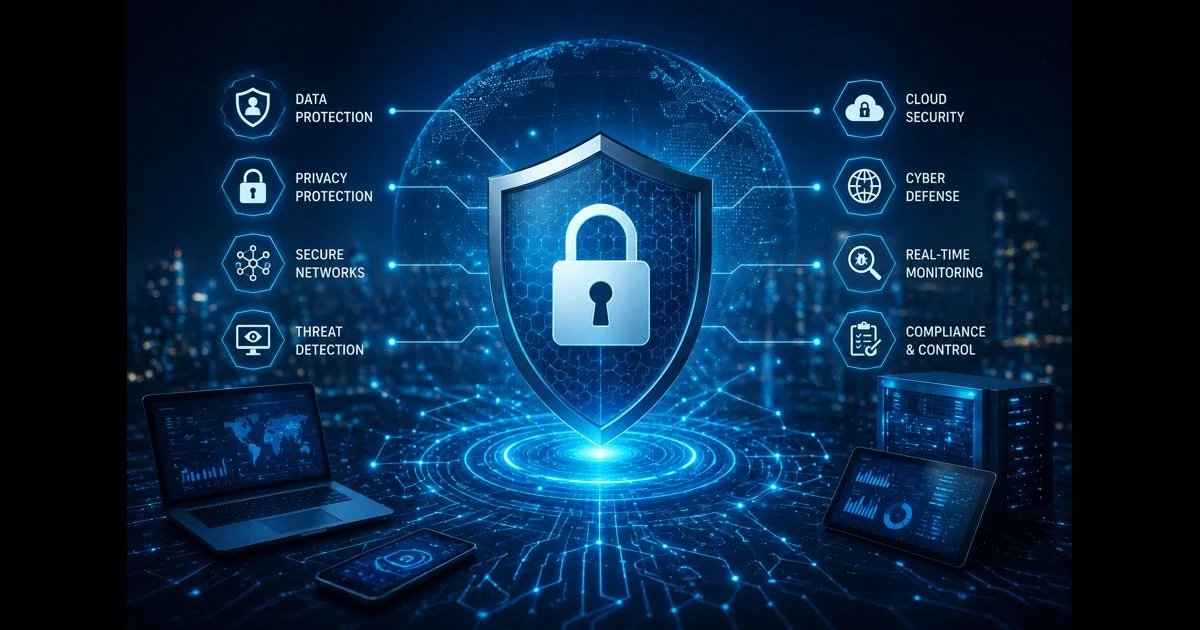
Cybersecurity is the coordinated protection of an organization’s accounts, devices, networks, applications, cloud services, and data. An effective security program combines governance, access controls, secure configuration, employee awareness, monitoring, tested backups, and incident response. Its purpose is to reduce avoidable risk and support reliable recovery when an incident occurs.
Organizations depend on digital systems for communication, payments, customer service, operations, and collaboration. This dependence makes security part of everyday business management rather than a responsibility limited to the IT department.
There is no single product that can secure an entire organization. Cybersecurity works through layers: understanding what must be protected, limiting access, maintaining systems, detecting unusual activity, preparing for disruption, and improving controls as technology and business needs change.
What Cybersecurity Protects
Cybersecurity covers the people, processes, information, and technology involved in digital operations. The exact scope differs between organizations, but it commonly includes:
- User and administrator accounts
- Laptops, phones, servers, and connected devices
- Business applications and websites
- Internal and external networks
- Cloud platforms and hosted services
- Customer, employee, and operational data
- Backups and recovery systems
- Third-party software and vendor access
- Email, messaging, and collaboration platforms
A useful security program begins with visibility. An organization cannot reliably protect an unknown device, forgotten account, unmanaged application, or unrecorded data store.
Maintaining an inventory of important assets does not require every organization to use the same tool. A small business may begin with a controlled register of devices, software, administrators, vendors, and data locations. A larger organization may need automated asset discovery and configuration-management systems.
The Core Objectives of Cybersecurity
Cybersecurity decisions are often organized around three established information-security objectives: confidentiality, integrity, and availability.
Confidentiality
Confidentiality means restricting information to authorized people and systems. Access controls, encryption, authentication, and data-handling rules can help prevent inappropriate disclosure.
Not every file requires identical protection. Public website content, internal procedures, employee records, payment information, and authentication secrets carry different levels of sensitivity. Data classification helps an organization apply controls according to risk.
Integrity
Integrity concerns the accuracy and reliability of information and systems. A record can cause harm if it is altered incorrectly even when it has not been publicly exposed.
Change approval, audit logs, version control, digital signatures, input validation, and restricted administrative access can help organizations identify or prevent unauthorized modifications.
Availability
Availability means keeping authorized access to systems and information when it is needed. Redundant infrastructure, tested backups, capacity planning, secure maintenance, and recovery procedures all contribute to availability.
Availability does not mean that a service can never fail. It means the organization has considered likely disruptions and prepared proportionate ways to maintain or restore critical operations.
Accountability
Accountability supports all three objectives. Reliable identity records and protected logs help establish who accessed a system, what action occurred, and when it happened.
Logging is most useful when records are reviewed, retained appropriately, protected from unauthorized alteration, and connected to an incident-handling process.
Common Cyber Threats
Cyber threats differ in motive and method. Some attacks exploit software weaknesses, while others target employees, vendors, or poorly controlled accounts.
| Threat | Typical point of exposure | Priority safeguards | Initial response |
| Phishing | Email, messages, or fraudulent sign-in pages | User awareness, email filtering, and phishing-resistant MFA | Report the message and review affected accounts |
| Credential theft | Reused, weak, or exposed passwords | Password manager, unique credentials, MFA, and sign-in monitoring | Reset credentials and revoke active sessions |
| Malware | Unsafe files, vulnerable software, or compromised websites | Endpoint protection, patching, application controls, and backups | Isolate the affected device and preserve relevant records |
| Ransomware | Compromised accounts, exposed services, or unpatched systems | Restricted privileges, segmentation, monitoring, and tested backups | Contain affected systems and activate the response plan |
| Data exposure | Excessive access, misconfiguration, or insecure sharing | Data classification, encryption, and access reviews | Restrict exposure and determine what information was affected |
| Insider misuse | Legitimate access used improperly | Least privilege, separation of duties, logging, and access reviews | Preserve evidence and follow the approved investigation process |
| Supply-chain compromise | Vendors, software dependencies, or integrations | Vendor review, controlled access, software inventory, and monitoring | Limit the affected connection and coordinate with the provider |
This table is a starting point, not a complete threat model. Each organization should assess threats in the context of its systems, information, responsibilities, and likely operational impact.
A Risk-Based Cybersecurity Framework
A practical security program can be organized around the six functions of the NIST Cybersecurity Framework: Govern, Identify, Protect, Detect, Respond, and Recover.
These functions provide a useful structure without requiring every organization to use identical technologies.
Govern
Governance establishes how cybersecurity decisions are made. It defines responsibility, acceptable risk, policies, oversight, and communication with leadership.
Useful governance questions include:
- Who is responsible for security decisions?
- Which systems and services are critical?
- What information requires the strongest protection?
- Which incidents must be escalated?
- How are vendors evaluated?
- How will security priorities be funded and reviewed?
Policies should reflect actual operations. A policy that employees cannot understand or follow provides limited protection.
Identify
The Identify function focuses on understanding assets, dependencies, vulnerabilities, data, and business risks.
An organization should know which devices, applications, cloud services, administrators, vendors, and data repositories support important operations. It should also understand the consequences if any of them become unavailable, altered, or exposed.
Protect
Protective measures reduce the likelihood or potential impact of an incident. Examples include MFA, access restrictions, encryption, secure configuration, patching, backups, network segmentation, and employee training.
Controls should be selected according to risk. An internet-facing administrative account generally requires stronger protection than an account with limited access to non-sensitive information.
Detect
Detection provides visibility into potentially harmful activity. Relevant signals may come from authentication logs, endpoint alerts, network monitoring, cloud audit records, application logs, and employee reports.
Collecting logs without reviewing or retaining them appropriately does not create effective detection. Organizations should determine which events matter, who receives alerts, and how suspicious activity will be investigated.
Respond
Response procedures guide the organization after an incident is identified. They establish responsibilities for investigation, containment, communication, documentation, and decision-making.
A response plan should be usable during a stressful event. Important contact details and procedures should remain available even if normal systems cannot be accessed.
Recover
Recovery restores services and supports improvement after disruption. It may involve rebuilding systems, restoring verified backups, validating configurations, monitoring for renewed activity, and reviewing lessons from the incident.
Recovery should be tested before an emergency. A backup that has never been restored cannot be assumed to meet the organization’s recovery needs.
Identity and Access Security
Many security incidents begin with a compromised or misused account. Identity security therefore deserves priority across local systems, cloud platforms, email, remote access, and business applications.
Use Multi-Factor Authentication
Multi-factor authentication requires more than one category of evidence before access is granted. It can reduce reliance on a password alone, although not all MFA methods provide the same resistance to phishing.
Where supported, organizations can prioritize phishing-resistant methods for administrators, email accounts, remote access, and systems containing sensitive information. Recovery options should also be protected because attackers may target them to bypass normal sign-in controls.
Apply Least Privilege
Least privilege limits people, applications, and services to the access required for their approved work.
This principle should apply to:
- Administrator permissions
- Shared folders and cloud drives
- Databases and business applications
- Service accounts and API credentials
- Vendor and contractor access
- Software deployment tools
- Backup administration
Permissions should be reviewed when responsibilities change and removed promptly when access is no longer needed. Dormant accounts and unnecessary administrator privileges create avoidable exposure.
Control the Account Lifecycle
Access management should cover the complete account lifecycle:
- Approve access based on a defined role.
- Create an individually attributable account.
- Apply appropriate authentication controls.
- Review privileges periodically.
- Adjust access when responsibilities change.
- Disable access when the relationship ends.
- Preserve required records according to policy.
Shared accounts should be avoided where individual accountability is important. If a technical system requires one, its use and credentials should be tightly controlled.
Securing Networks, Devices, Applications, and Cloud Services
Digital systems are interconnected, but each layer presents different risks.
Network Security
Network security manages how users, devices, applications, and services communicate. Relevant controls may include firewalls, secure remote access, traffic monitoring, segmentation, encrypted connections, and restrictions on exposed services.
Segmentation can limit how easily an incident moves from one part of an environment to another. Critical systems, backup infrastructure, employee devices, guest networks, and unmanaged equipment should not automatically receive unrestricted access to one another.
Endpoint Security
Laptops, workstations, servers, phones, and other connected devices are common entry points. Endpoint protection may include:
- Supported operating systems
- Timely security updates
- Device encryption
- Malware and behavior monitoring
- Screen-lock requirements
- Controlled software installation
- Remote management
- Secure disposal or reassignment
Organizations should also define how lost devices, departing employees, and unsupported hardware are handled.
Application Security
Application security should begin during design and continue through development, testing, deployment, and maintenance.
Secure development includes appropriate authentication, authorization, input validation, dependency management, secret protection, logging, and security testing. The OWASP Application Security Verification Standard provides a structured reference for evaluating technical security controls in web applications.
Automated scans can identify some weaknesses, but they do not replace secure architecture, appropriate testing, or informed review.
Cloud Security
Cloud providers and customers usually manage different parts of the environment. The provider may secure the underlying service infrastructure, while the customer remains responsible for matters such as identities, permissions, data, application settings, and service configuration.
Organizations planning broader cloud computing adoption should document who controls each security responsibility.
Common cloud risks include public storage, excessive administrator access, exposed credentials, incomplete logging, unmanaged integrations, and inconsistent configuration. Smaller organizations can use a cloud security checklist to review access, backups, encryption, configuration, monitoring, and incident preparation.
Data Protection and Privacy
Cybersecurity and privacy are related but not identical.
Cybersecurity focuses on protecting systems and information against unauthorized access, alteration, loss, or disruption. Privacy addresses how personal information is collected, used, shared, retained, and disposed of.
Strong data protection begins with four questions:
- What information is collected?
- Where is it stored?
- Who can access it?
- How long is it genuinely needed?
An organization may create unnecessary risk by keeping information without a defined business or legal purpose. Data minimization and retention controls can reduce the volume of information exposed during an incident.
Data Classification
A simple classification model might separate information into:
- Public
- Internal
- Confidential
- Restricted
The labels should connect to practical handling rules. For example, restricted information may require stronger access controls, encryption, approved storage, limited sharing, and documented disposal.
Encryption and Key Management
Encryption can protect information in storage and during transmission. Its effectiveness depends on appropriate implementation, access control, and key management.
Encryption should not be described as a complete solution. If an attacker gains access through an authorized account or obtains the relevant keys, encrypted information may still be exposed.
Backups
Backups support recovery from deletion, corruption, hardware failure, and some security incidents. An effective backup process should address:
- Which information and systems are included
- How frequently backups are created
- Who can access or delete them
- Whether a separate or isolated copy exists
- How long backups are retained
- How restorations are tested
- Which systems must be recovered first
Testing matters because successful backup creation does not automatically confirm successful restoration.
Vulnerability and Patch Management
A vulnerability-management program identifies weaknesses, assesses their relevance, prioritizes action, and verifies remediation.
A practical process includes:
- Maintain an inventory of hardware and software.
- Identify unsupported or unapproved technology.
- Monitor vendor advisories and trusted vulnerability sources.
- Scan relevant systems where appropriate.
- Evaluate exposure, exploitability, and business impact.
- Prioritize remediation.
- Test and deploy updates or compensating controls.
- Confirm that the weakness has been addressed.
Severity scores are useful, but they should not be the only priority signal. An actively exploited vulnerability on an exposed critical system may require faster action than a higher-scoring weakness in an isolated, low-impact environment.
The CISA Known Exploited Vulnerabilities Catalog can help organizations identify vulnerabilities with evidence of exploitation. The catalog should inform prioritization rather than replace an organization’s own risk assessment.
Zero Trust as an Access Strategy
Zero Trust is an approach to access, not a single product.
It avoids granting broad trust solely because a person or device is connected to an internal network. Access decisions instead consider factors such as identity, device condition, requested resource, permissions, and relevant context.
Practical Zero Trust measures can include:
- Strong identity verification
- Device health requirements
- Least-privilege permissions
- Segmented access
- Protected service identities
- Continuous logging
- Regular access reviews
An organization does not become secure simply by adopting the Zero Trust label. The value comes from implementing and maintaining appropriate controls.
Security Monitoring and Incident Response
Security monitoring helps organizations identify unusual activity early enough to investigate and respond.
Useful sources of evidence may include:
- Sign-in and authentication records
- Administrator activity
- Endpoint alerts
- Network events
- Cloud audit logs
- Application errors
- Data-access records
- Employee and customer reports
Monitoring should be proportionate and lawful. Organizations should define what is collected, why it is needed, who can access it, and how long it is retained.
A Practical Incident-Response Process
The NIST incident-response guidance connects incident preparation, detection, response, and recovery with broader cybersecurity risk management.
A usable process should cover the following actions:
Prepare
Define responsibilities, escalation paths, communication methods, technical procedures, external contacts, and recovery priorities before an incident occurs.
Identify and Assess
Determine what happened, which assets may be affected, what evidence is available, and whether the activity is continuing.
Early information may be incomplete. Teams should distinguish verified findings from assumptions.
Contain
Limit further exposure while considering operational consequences and evidence preservation. Containment may involve isolating devices, disabling accounts, blocking connections, or restricting a service.
Eradicate and Recover
Remove the identified cause, correct weaknesses, restore systems safely, validate normal operations, and monitor for signs of continued activity.
Review
Document what occurred, which controls worked, where delays arose, and what changes are needed. The purpose of the review is to improve readiness, not merely to close the incident record.
Organizations should seek appropriate technical, legal, insurance, or regulatory support when the circumstances require it.
Third-Party and Supply-Chain Security
Organizations may share systems or data with cloud providers, software vendors, payment processors, contractors, consultants, and other partners. These relationships can create dependencies that need to be understood and controlled.
Before providing access, an organization can assess:
- What data or systems the provider will access
- Whether that access is necessary
- How accounts and credentials are protected
- How security incidents will be reported
- What subcontractors or integrations are involved
- How access will be removed
- What happens to data when the relationship ends
- How service interruption would affect operations
Vendor questionnaires and contracts can support risk management, but neither guarantees security. Technical access restrictions and ongoing oversight remain important.
Employee Awareness Without Blame
Employees regularly make security decisions when opening messages, approving requests, handling information, using cloud applications, and reporting unusual activity.
Effective awareness programs should teach practical actions rather than rely on fear. Training may cover:
- Recognizing suspicious messages and sign-in pages
- Verifying unusual payment or data requests
- Using approved password and MFA tools
- Reporting lost devices
- Handling confidential information
- Avoiding unapproved software and cloud services
- Reporting mistakes promptly
A reporting culture matters. Employees may delay asking for help if they expect automatic blame, allowing a manageable event to become more serious.
Training should be reinforced with usable technical controls. Employees should not be expected to compensate for insecure systems through vigilance alone.
Artificial Intelligence and Cybersecurity
Artificial intelligence can assist with log analysis, alert prioritization, anomaly detection, and investigation. It can also produce incorrect conclusions or overlook important context.
AI-generated findings should therefore be treated as inputs to security decisions, not unquestionable evidence. Organizations using AI in security operations should consider data access, privacy, model limitations, auditability, human review, and the consequences of incorrect automation.
The same care applies when employees use public AI services. Sensitive information, credentials, confidential code, or customer records should not be entered into unapproved tools.
Security requirements should be considered during digital transformation planning rather than added only after new systems are deployed.
A Practical Cybersecurity Priority Plan
Organizations with limited time or resources can begin with controls that address common and consequential exposure.
| Priority | Action | Evidence of completion |
| 1 | Identify critical systems, data, accounts, and vendors | Reviewed asset and dependency register |
| 2 | Protect email, administrator, and remote-access accounts with appropriate MFA | MFA enrollment and exception report |
| 3 | Remove dormant accounts and unnecessary privileges | Documented access review |
| 4 | Update internet-facing and critical systems | Patch or remediation records |
| 5 | Review cloud storage, sharing, and administrator settings | Configuration review results |
| 6 | Protect and test backups | Successful restoration record |
| 7 | Centralize important security logs and define alerts | Confirmed log sources and alert ownership |
| 8 | Document incident contacts and first-response steps | Approved and accessible response plan |
| 9 | Review vendor access and integrations | Current third-party access register |
| 10 | Run a realistic incident exercise | Findings and assigned improvement actions |
The order may change according to the organization’s risks. For example, a business with an exposed unsupported server may need to address that system before beginning a broader policy project.
Cybersecurity Checklist
Use this checklist as a review aid rather than proof that every risk has been resolved.
Governance
- Security responsibilities are assigned.
- Critical services and information are identified.
- Important policies reflect actual working practices.
- Security risks are reviewed with appropriate leadership.
- Incident escalation and communication responsibilities are documented.
Identity and Access
- Sensitive accounts use appropriate MFA.
- Administrator access is limited and separately controlled.
- Dormant and departed-user accounts are disabled.
- Permissions are reviewed regularly.
- Service and recovery accounts are protected.
Systems and Applications
- Hardware and software inventories are maintained.
- Supported systems receive security updates.
- Internet-facing services are reviewed.
- Endpoints use appropriate protection and encryption.
- Applications follow secure development and maintenance practices.
Data and Recovery
- Sensitive information is identified and classified.
- Access to confidential information is restricted.
- Encryption is applied where appropriate.
- Retention and disposal requirements are defined.
- Backups are protected and restoration is tested.
Detection and Response
- Important logs are available and protected.
- Security alerts have assigned owners.
- Employees know how to report suspicious activity.
- An incident-response plan is accessible.
- Response and recovery procedures are exercised.
Vendors and Cloud Services
- Third-party access is documented.
- Unnecessary integrations are removed.
- Cloud permissions and public exposure are reviewed.
- Security responsibilities are understood.
- Provider access is removed when a relationship ends.
Frequently Asked Questions
What is cybersecurity?
Cybersecurity is the practice of protecting digital accounts, devices, networks, applications, services, and information against unauthorized access, alteration, loss, and disruption.
What is the difference between cybersecurity and data privacy?
Cybersecurity supplies safeguards against unauthorized access and disruption. Data privacy addresses how personal information is collected, used, shared, retained, and disposed of. A responsible information-management program normally considers both.
What are the most common cybersecurity threats?
Common threats include phishing, credential theft, malware, ransomware, insecure configurations, unpatched vulnerabilities, excessive access, insider misuse, and compromised vendors or software dependencies.
Is multi-factor authentication enough to secure an account?
MFA can strengthen account protection, but it is not a complete defense. The method used, account-recovery process, device security, user permissions, session controls, and monitoring also affect risk.
Does antivirus software provide complete protection?
No individual security product provides complete protection. Endpoint protection can help identify certain threats, but it should operate alongside updates, access controls, secure configuration, monitoring, backups, and employee awareness.
How often should cybersecurity controls be reviewed?
Review frequency should reflect risk and operational change. Access should be reconsidered when roles change, critical vulnerabilities may require prompt attention, and incident procedures should be exercised periodically. Major technology or vendor changes should also trigger review.
Can small businesses use a cybersecurity framework?
Yes. Frameworks such as the NIST Cybersecurity Framework can be adapted to an organization’s size, resources, and risk. A small business may begin with a limited set of high-priority controls and improve them over time.
Can cybersecurity eliminate every cyberattack?
No. Cybersecurity reduces exposure and improves detection, response, and recovery. It cannot guarantee that an incident will never occur.
Final Thoughts
Cybersecurity is most effective when it is treated as a continuing business process. Organizations need to understand their technology, protect important access, maintain systems, monitor relevant activity, prepare for incidents, and test their ability to recover.
The strongest starting point is not necessarily the most complex technology. Clear ownership, accurate asset information, controlled privileges, appropriate MFA, timely remediation, protected backups, and a usable response plan can address important areas of exposure.
Security decisions should remain proportionate to the organization’s systems, information, operational needs, and risk. As those conditions change, the cybersecurity program should be reviewed and improved accordingly.


Pingback: Cloud Cost Optimization Checklist for Small Business
Pingback: Quikconsole Com: An Informational Publication
Pingback: QuikConsole Security Guide: Passwords & Online Safety
Pingback: Cloud Console Governance Guide: Access, Control & Cost
Pingback: Security Controls for Business: Access, Devices & Recovery
Pingback: Online Technology Website: How to Check Trustworthiness
Pingback: Cybersecurity Tool Evaluation Checklist: What to Review
Pingback: Cloud Storage Security Checklist for Business