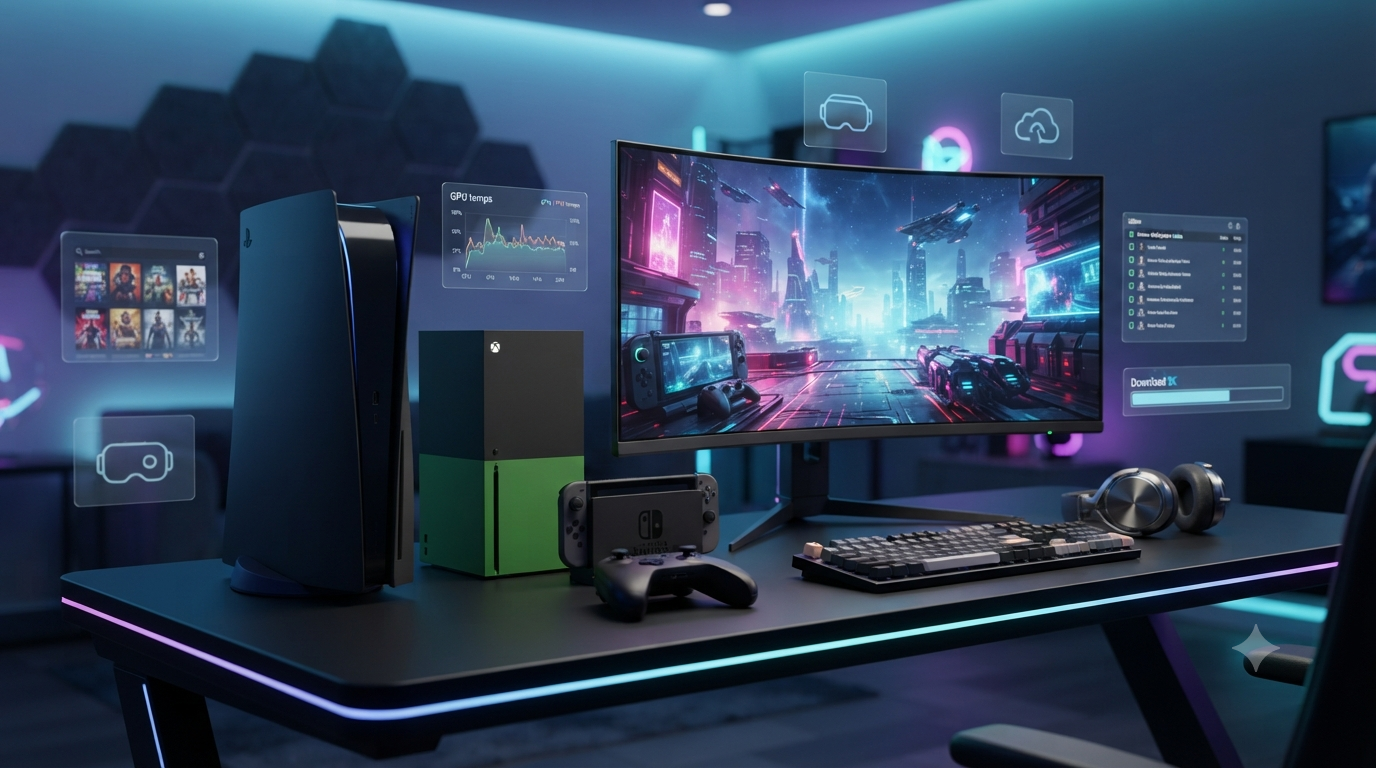
Gaming consoles are dedicated devices designed to run video games through a television, monitor or built-in screen. They combine hardware, operating software, game libraries, controllers, online services and account features in one gaming system.
People searching Gaming Consoles QuikConsole Com may be looking for information about console types, performance, storage, game access, online play, family controls, cloud gaming and the differences between consoles and computers. This guide explains those subjects clearly so readers can understand what matters before choosing or using a gaming console.
What Is a Gaming Console?
A gaming console is an electronic device built primarily for playing video games. Unlike a general-purpose computer, a console normally uses a controlled hardware and software environment designed around gaming.
A typical console may include:
- A processor for running game software
- Graphics hardware for displaying images
- Internal storage for games and saved data
- Wireless or wired network connectivity
- Ports for controllers, displays and accessories
- An operating system for managing games and settings
- Online account features
- Security and family-management controls
Some consoles connect to a television or monitor, while others have their own screen and can be used away from a fixed setup.
A console does not automatically include every game. The available games depend on the system’s compatible library, the publisher’s support and the way the game is distributed.
Main Types of Gaming Consoles
Home Consoles
A home console is designed to remain connected to a television or monitor. It normally uses separate controllers and may support local multiplayer, online gaming, digital downloads and physical game media.
Home consoles may suit people who prefer:
- A larger display
- Comfortable controller-based gaming
- Local multiplayer
- A fixed gaming setup
- Higher visual performance than many portable devices
The system should be placed in a ventilated area with enough space around its air vents. Blocking ventilation can contribute to overheating and reduced performance.
Handheld Consoles
A handheld console includes a built-in display and controls. It can be used without a television, although some devices may also support connection to a larger screen.
Handheld consoles are useful for people who value:
- Portable gaming
- A self-contained device
- Short gaming sessions
- Playing away from a desk or television
- Physical controls instead of touchscreen-only input
Battery life, screen visibility, storage capacity, comfort and repair options are important when evaluating a handheld device.
Hybrid Consoles
A hybrid console can be used as a portable system and as a home gaming device. The exact method of switching between modes depends on the hardware.
A hybrid system may be suitable for households where different people use the same device in different ways. However, buyers should check how the system performs in each mode instead of assuming that portable and television use will provide identical results.
Cloud-Gaming Devices
Some devices are designed mainly to access games through a remote cloud service. In this arrangement, much of the game processing takes place on remote servers, while the device receives and displays the streamed result.
Cloud gaming depends heavily on:
- Internet speed
- Network stability
- Latency
- Server availability
- Account access
- Service compatibility
- Subscription or purchase requirements
Cloud gaming can reduce the need for powerful local hardware, but it does not remove the need for a reliable internet connection. A user with unstable connectivity may experience delays, image quality changes or interruptions.
How to Choose the Right Gaming Console
There is no single console that suits every player. The right choice depends on how the device will be used, which games are required and what limitations matter most.
Start With the Game Library
The game library should be checked before hardware design or appearance. A console may be unsuitable if it does not support the games a player wants to use.
Before buying, check:
- Whether the required games are available
- Whether they run directly on the device
- Whether they require an online connection
- Whether the game is sold digitally or physically
- Whether additional subscriptions are needed
- Whether older games are supported
- Whether saved progress transfers between devices
A console’s advertised capabilities are less important if its compatible game library does not meet the user’s needs.
Consider the Display and Resolution
Home consoles usually connect to a television or monitor. The display affects the final visual experience, but the console and game must also support the relevant output settings.
Important considerations include:
- Display size
- Refresh rate
- Supported resolution
- Available connection ports
- Input delay
- HDR support, if relevant
- Distance between the player and the screen
A more expensive display does not guarantee a better result if the console or game cannot use its capabilities.
Check Storage Requirements
Modern games can require substantial storage space, and additional downloadable content may increase the amount needed. System updates and saved data also use storage.
Before choosing a console, check:
- Usable storage rather than advertised total capacity
- Support for expandable storage
- The cost and compatibility of expansion options
- Whether games can be moved between internal and external storage
- Whether saved data is stored locally, online or in both locations
Limited storage can become inconvenient when several large games are installed at the same time.
Review Portability Needs
For a portable device, portability involves more than size. A smaller console may be easier to carry but less comfortable for long sessions.
Consider:
- Weight
- Grip comfort
- Button placement
- Screen brightness
- Battery performance
- Charging method
- Durability during transport
- Availability of protective accessories
A portable console should be comfortable for the type of sessions the user expects to play.
Understand Online Requirements
Some games work offline, while others depend on online services for multiplayer, updates, account verification or cloud-based features.
Check whether the intended games require:
- A permanent internet connection
- An online account
- A paid online membership
- Voice or text communication
- Cloud saving
- Regular content updates
Online requirements can affect both cost and convenience, especially in homes with limited or unreliable connectivity.
Physical Games and Digital Games
Gaming consoles may support physical game media, digital downloads or both.
Physical Games
Physical games may be useful for people who prefer a tangible copy or want to share, resell or replace a disc or cartridge where the platform allows it.
However, physical media may still require:
- Installation
- Updates
- Storage space
- Account access
- Online verification in some cases
Owning physical media does not always mean that every part of the game works without internet access.
Digital Games
Digital games are downloaded to the console and linked to an account or platform library.
Advantages may include:
- Immediate access after purchase
- No physical media storage
- Easy switching between installed titles
- Automatic delivery of updates
Digital ownership also creates account-related responsibilities. Losing access to an account, forgetting credentials or failing to protect the account can affect access to purchased content.
Gaming Console Accounts and Privacy
A gaming account may contain personal information, purchase records, saved data, communication settings and connected payment details.
Users should:
- Use a strong, unique password
- Enable multi-factor authentication where available
- Avoid sharing account credentials
- Review connected devices and active sessions
- Use purchase confirmation controls
- Check privacy settings
- Limit communication from unknown users
- Keep recovery information current
- Avoid entering account details on unfamiliar websites
A console account should be treated like any other important online account. The device itself may be secure, but weak account practices can still expose personal information or purchases.
Family Safety and Spending Controls
Gaming consoles commonly include settings that help parents or guardians manage how a child uses the device. The exact controls vary by platform and account type.
Useful settings may include:
- Age-based content restrictions
- Play-time limits
- Communication controls
- Friend and contact permissions
- Purchase approvals
- Spending limits
- Download restrictions
- Privacy settings
- Restrictions on web or external content
These controls should be reviewed regularly because games, accounts and household circumstances can change. Technical settings are helpful, but they work best when combined with clear family rules and supervision appropriate to the child’s age.
Local Multiplayer and Online Multiplayer
Local multiplayer takes place on the same device or within the same physical location. It may require extra controllers, separate profiles or a game that supports multiple players.
Online multiplayer connects players through the internet. It may involve:
- Platform accounts
- Game-specific accounts
- Voice communication
- Text communication
- Matchmaking
- User-generated content
- In-game purchases
Players should avoid sharing personal information with strangers and should use reporting, blocking and privacy tools when available. Parents should understand how communication works before allowing children to use online multiplayer features.
Gaming Consoles, Cloud Services and Saved Data
Some gaming systems use cloud services for saved-game backups, account synchronization, streaming or remote access. These features can be convenient, but they should not be misunderstood.
Cloud storage for saved data may depend on:
- The platform account
- A specific subscription
- Internet access
- The game’s support for synchronization
- The correct account being used on the device
Cloud storage is not always the same as a complete backup of every game file, setting or piece of downloadable content. Users should check what is actually synchronized and whether restoration is possible before relying on it.
The wider difference between a gaming console and a cloud-management console is explained in this guide to cloud console management. A gaming console is mainly used for entertainment, while a cloud console is an administrative interface for managing digital infrastructure and services.
Gaming Consoles Compared With Computers
Gaming consoles and computers can both run video games, but they provide different experiences.
Gaming Console Advantages
A console may offer:
- A simpler setup
- Consistent hardware
- Dedicated controller support
- Easy connection to a television
- A controlled operating environment
- Less need for hardware upgrades
Computer Advantages
A computer may offer:
- Greater hardware flexibility
- Upgrades and customization
- Broader software use
- More control over graphics settings
- Support for work, study and gaming on one device
- Access to different input methods
Which One Should You Choose?
A console may suit someone who wants straightforward gaming with limited configuration. A computer may be more suitable for someone who wants upgrade options, broader software use or detailed control over performance.
The decision should be based on game requirements, budget, space, preferred controls and the amount of technical management the user is comfortable handling.
Common Gaming Console Problems
Insufficient Storage
If the console frequently reports low storage, remove unused games, review downloadable content and consider a compatible storage expansion. Do not delete saved data without checking whether it is synchronized or backed up.
Slow Downloads
Download speed can be affected by the internet connection, network congestion, wireless signal strength, server demand and other devices using the same connection.
Moving the console closer to the router, using a wired connection where practical and reducing other heavy network activity may help. These steps cannot fix every service-side or connection problem.
Overheating
A console needs clear airflow. Keep vents unobstructed, avoid placing the device inside a tightly enclosed cabinet and clean visible dust carefully according to the manufacturer’s instructions.
Repeated overheating, unexpected shutdowns or unusual noise may require professional inspection.
Account Access Problems
Account problems may result from forgotten credentials, incorrect recovery details, security alerts or use of the wrong account. Users should use the platform’s official recovery process and avoid third-party services that request account passwords.
Controller Connection Issues
Check battery charge, cable condition, wireless pairing and compatibility. If only one game has a controller problem, the issue may be related to the game’s settings rather than the hardware.
Safe Gaming Console Maintenance
Good maintenance includes:
- Keeping system software updated
- Installing games from trusted sources
- Protecting account credentials
- Maintaining ventilation
- Using suitable power accessories
- Avoiding liquid and excessive heat
- Reviewing privacy settings
- Checking storage before deleting data
- Backing up supported saved data
- Selling or giving away a device only after removing personal accounts
A console should be reset before transfer to another person. Users should also remove payment details and confirm that personal data is no longer stored on the device.
Frequently Asked Questions
What are gaming consoles used for?
Gaming consoles are mainly used to play video games through a television, monitor or built-in screen. Depending on the platform, they may also support media apps, online communication, digital stores and cloud-based features.
Which type of gaming console is best?
The suitable type depends on the user’s games, display, portability needs, storage requirements, online access and budget. A home console may suit fixed setups, while a handheld or hybrid system may be more practical for portable use.
Are gaming consoles better than computers?
Neither is universally better. Consoles generally provide a simpler and more consistent gaming setup, while computers offer more flexibility and upgrade options.
Do gaming consoles require the internet?
Not always. Some games can be played offline, while others require internet access for downloads, updates, account verification, multiplayer or cloud features.
Can gaming consoles use cloud gaming?
Some consoles and related devices support cloud gaming, but availability depends on the platform, game, account, service and internet connection.
Are digital games safer than physical games?
Digital and physical games have different risks and conveniences. Digital games require account protection, while physical games may still require installation, updates or online access. The safer option depends on how the user manages the device, account and purchases.
How can parents make a gaming console safer for children?
Parents can review content restrictions, communication settings, purchase controls, privacy options and play-time limits. These settings should be combined with age-appropriate supervision.
Can a gaming console replace a computer?
A gaming console can replace some entertainment functions, but it generally does not replace a computer for tasks such as full document editing, programming, advanced file management or professional software.
What should be checked before buying a gaming console?
Check the compatible game library, storage, display requirements, controller design, online requirements, account rules, accessory costs, portability and family-safety features.
Final Thoughts
Gaming consoles are not defined only by their graphics or appearance. A practical choice also depends on game compatibility, storage, online requirements, account security, portability, family controls and long-term convenience.
The best decision is the one that matches the player’s actual use. Reviewing these factors before purchase helps avoid choosing a device that lacks the required games, depends on unsuitable online services or provides less storage and flexibility than expected.
The term gaming consoles QuikConsole Com should therefore be understood as a search for clear information about gaming-console types, features, safety, cloud services and practical use—not as evidence that QuikConsolee com sells consoles, provides exclusive deals or operates a gaming platform.