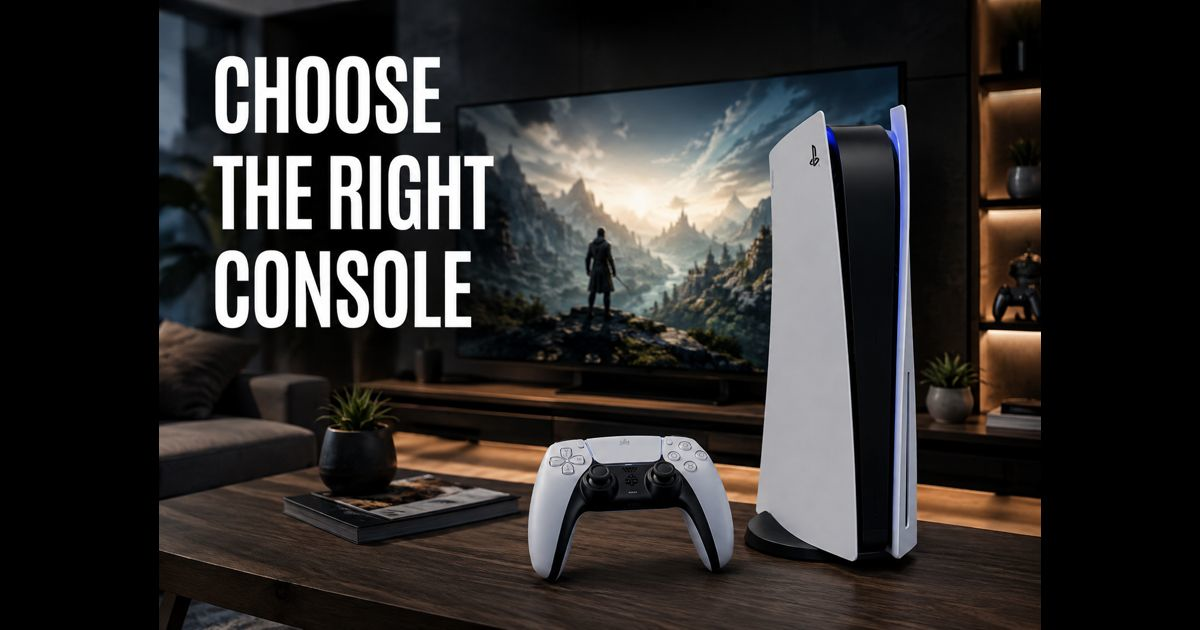
A gaming console should be chosen around the games, people, screen, budget, and play style that will shape everyday use. Processing power matters, but it is only one part of the decision. A system with the right game library, comfortable controller, suitable storage, and sensible account settings can be a better long-term fit than a more expensive device with features that go unused.
The wording “gaming console gaming console quikconsole com” appears beside material about video-game systems. It should not be taken as proof that QuikConsole operates a console manufacturer, gaming-control service, or product platform. Publicly visible material supports viewing QuikConsolee as an informational website, not as an official authority for PlayStation, Xbox, Nintendo, or any other gaming brand. A separate evidence-based overview of QuikConsole explains why those distinctions matter.
Start With the Games You Actually Want to Play
A console is an entry point into an ecosystem, not just a piece of hardware. Before comparing specifications, list the games that matter most.
Some games are available across several systems. Others are associated with a particular platform, subscription catalog, or online community. A household that already owns digital games, controllers, or a paid membership may also have a practical reason to remain within the same ecosystem.
Check these points before buying:
- Whether the preferred games are available on the system.
- Whether existing purchases can be accessed.
- Whether friends use the same online service for multiplayer games.
- Whether a physical disc version or download-only version suits the household.
- Whether local multiplayer is important.
This first step prevents a common mistake: buying based on a general “best console” label and then discovering that the games or social features that matter most are elsewhere.
Choose a Playing Style Before Comparing Technical Specs
Home consoles are built mainly for use with a television or monitor. They are suitable for longer sessions, local multiplayer, large displays, and a fixed entertainment space. Their performance, storage options, disc support, and online services vary by model.
Hybrid systems combine television play with portable play. This flexibility can be useful for shared homes, travel, or players who do not always have access to one screen. Portability also creates different considerations, including battery life, protective storage, and the risk of loss or damage outside the home.
Handheld gaming PCs offer another path. They can provide access to PC game libraries in a portable format, but the experience may involve more setup, settings adjustments, updates, and compatibility checks than a traditional console.
No category is automatically better. The appropriate choice depends on where games will be played and how much simplicity, portability, or technical flexibility is wanted.
Understand the Difference Between a Disc Drive and Digital Purchases
A disc drive affects more than the way games are installed. It can affect resale options, borrowing, second-hand purchases, and access to older physical collections. Digital-only systems remove the need to swap discs, but they tie purchases to an account and storefront.
A digital game is normally a license connected with the account used to acquire it. That means account recovery, two-factor authentication, and secure payment settings become part of protecting the library. It also means that a low-priced digital-only console may lead to different spending patterns over time than a disc-capable model.
For a physical-media household, confirm that the model includes the needed drive. For a download-focused household, look beyond the console price and consider storage capacity, internet reliability, and the cost of future games.
Storage Can Change the Experience Quickly
Modern games can occupy substantial space. A console that seems adequate on the first day may require storage management after a few large installations, updates, screenshots, and downloadable content.
Before purchasing, check:
- Usable internal storage rather than only the number printed on the box.
- Whether storage can be expanded and which expansion method is supported.
- Whether older games can run from external storage or only be archived there.
- The likely number of regularly played games in the household.
- The cost of compatible expansion storage.
Storage is not a reason to automatically choose the most expensive version. It is a reason to plan realistically. A player who rotates among a few games may be comfortable with less space than a family sharing several games at once.
Calculate the Full Cost of Ownership
The console price is only the first expense. A realistic budget includes games, online multiplayer access where required, subscriptions, storage, an additional controller, headphones, and possible protection plans.
Subscription services can offer value for players who finish many games or want a changing catalog. They are less useful when someone plays only one or two specific titles for long periods. Review the current catalog, renewal price, online-play requirements, and cancellation terms rather than assuming that every subscription will save money.
Avoid making a purchase decision from temporary discounts alone. A bundle may be worthwhile when it includes a game or accessory that would genuinely be bought anyway. It is less valuable when it adds items that will remain unused.
Check Display and Audio Compatibility
A gaming console does not need the most expensive television to be enjoyable. However, the screen and connection setup influence image quality, refresh options, input response, and available features.
Check whether the current television or monitor has suitable HDMI ports and supports the settings that matter to the player. A large 4K television may suit a living room setup, while a monitor may be more practical for a desk. Headphones can help in shared spaces, but confirm compatibility with the console and controller before buying.
Technical labels should be treated as capabilities, not guarantees. Game-by-game support varies, and visual settings can involve trade-offs between higher image detail and smoother motion.
Family Accounts, Privacy, and Spending Controls Matter
A console used by a child should be set up with a separate child account rather than an adult account shared by everyone. This allows the account holder to apply age ratings, playtime rules, purchase permissions, communication controls, and privacy settings more precisely.
On PlayStation systems, family management can control access to games and content, communication, privacy, playtime, and monthly spending limits. These settings work best when the child uses their own verified account and cannot change the parent’s controls.
Set up safety controls before downloading games or adding a payment method:
- Create separate accounts for each player.
- Turn on multi-factor authentication for the adult account.
- Restrict purchases or require a password for every purchase.
- Review voice chat, friend requests, user-generated content, and profile visibility.
- Check age ratings for games and downloadable content.
- Revisit settings as a child’s needs and maturity change.
Parental controls support household rules; they do not replace conversations about online behavior, spending, and respectful communication.
Buying Used Can Be Sensible With Care
A used console can lower the initial cost, especially for a household that does not need the latest hardware. The condition of the controller, disc drive, ports, cooling system, and included cables matters as much as the console’s appearance.
When buying pre-owned:
- Test the controller sticks, buttons, triggers, and wireless connection.
- Confirm that the console can connect to the internet and install updates.
- Inspect ports for damage and listen for unusually loud fan noise.
- Ensure the seller has removed all personal accounts and reset the device.
- Check the return policy and whether the retailer provides a warranty.
- Compare the used price with sales on new or refurbished units.
Do not buy a device that is still linked to someone else’s account or presented as a way to bypass platform security. That can lead to locked purchases, account disputes, or loss of access.
A Practical Way to Make the Final Choice
The clearest choice is usually the one that answers the household’s real needs with the fewest compromises.
Choose around the game library when certain titles or friends matter most. Choose around portability when gaming happens in more than one place. Choose around family management when the console will be shared with children. Choose around total ownership cost when the budget is fixed. Choose around physical media when borrowing, collecting, or second-hand games are important.
A console does not need to win every comparison to be the right one. It needs to fit the games, habits, budget, and safeguards that will matter after the first week of ownership.
Frequently Asked Questions
Is the most powerful gaming console always the best choice?
No. Higher performance can be valuable, but game availability, cost, storage, portability, controller comfort, and multiplayer needs can be more important for a particular player.
Should a family choose physical games or digital games?
Physical games can be borrowed, resold, and purchased used. Digital games are convenient and do not require disc changes. The better option depends on buying habits, storage needs, and whether account-based ownership is comfortable for the household.
Are gaming consoles safe for children?
They can be used more safely when each child has a separate account and the household sets age ratings, privacy, communication, playtime, and spending controls before regular use.
Does QuikConsole provide gaming-console services?
Publicly available information does not establish QuikConsole as a gaming-console service, hardware maker, or gaming-management platform. It is more accurately treated as an informational website discussing technology-related subjects.